Untitled case file
Transcription
37
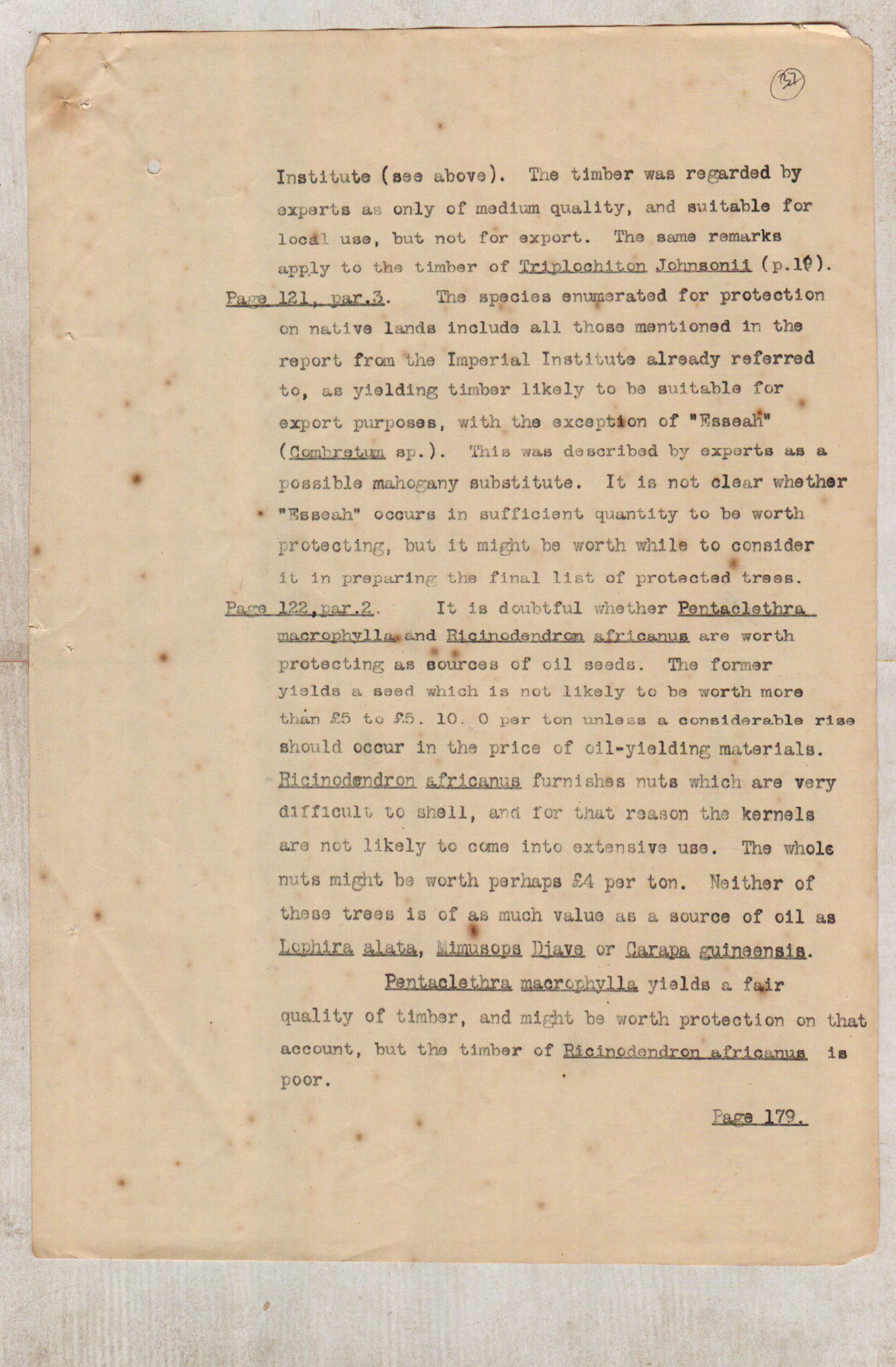
Institute (see above). The timber was regarded by exports a only of medium quality, and suitable for use, but not for export. The same remarks apply to the timber of Triplochiton Johnsonii (p.11).
Page 121,par.3. The species enumerated for protection on native lands include all those mentioned in the report from the Imperial Institute already referred to, as yielding timber likely to he suitable for export puroses, with the exception of “Esseah"(combretum sp.) This was described by experts as a possible mahogany substitute. It is not clear whether “Esseah" occurs in sufficient quantity to be worth protecting, but it might be worth while to consider it in preparing the final list of protected trees.
Page 122, par .2. It is doubtful whether Pentaclethra macrophylla and Ricinodendrom africanus are worth protecting as sources of oil seeds. The former yields a seed which is not likely to be worth more than £5 to £5. 10. 0 per ton unless a considerable rise should occur in the price of oil-yielding materials.Ricinodendrom africanus furnishes nuts which are very difficult to shell, and for that reason the kernels are not likely to come into extensive use. The whole nuts might be worth perhaps £4 per ton. Neither of these trees is of a much value as a source of oil as Lophira alata, mimusops Djave or Carapa guineensis.
Pentaclethra macrophylla yields a fair quality of timber, and might be worth protection on that account, but the timber of Ricinodondron africanus is poor.
Page 179.
Typed from the scan. Spellings follow the original and may contain mistakes.