Rubber Cultivation (colony)
Transcription
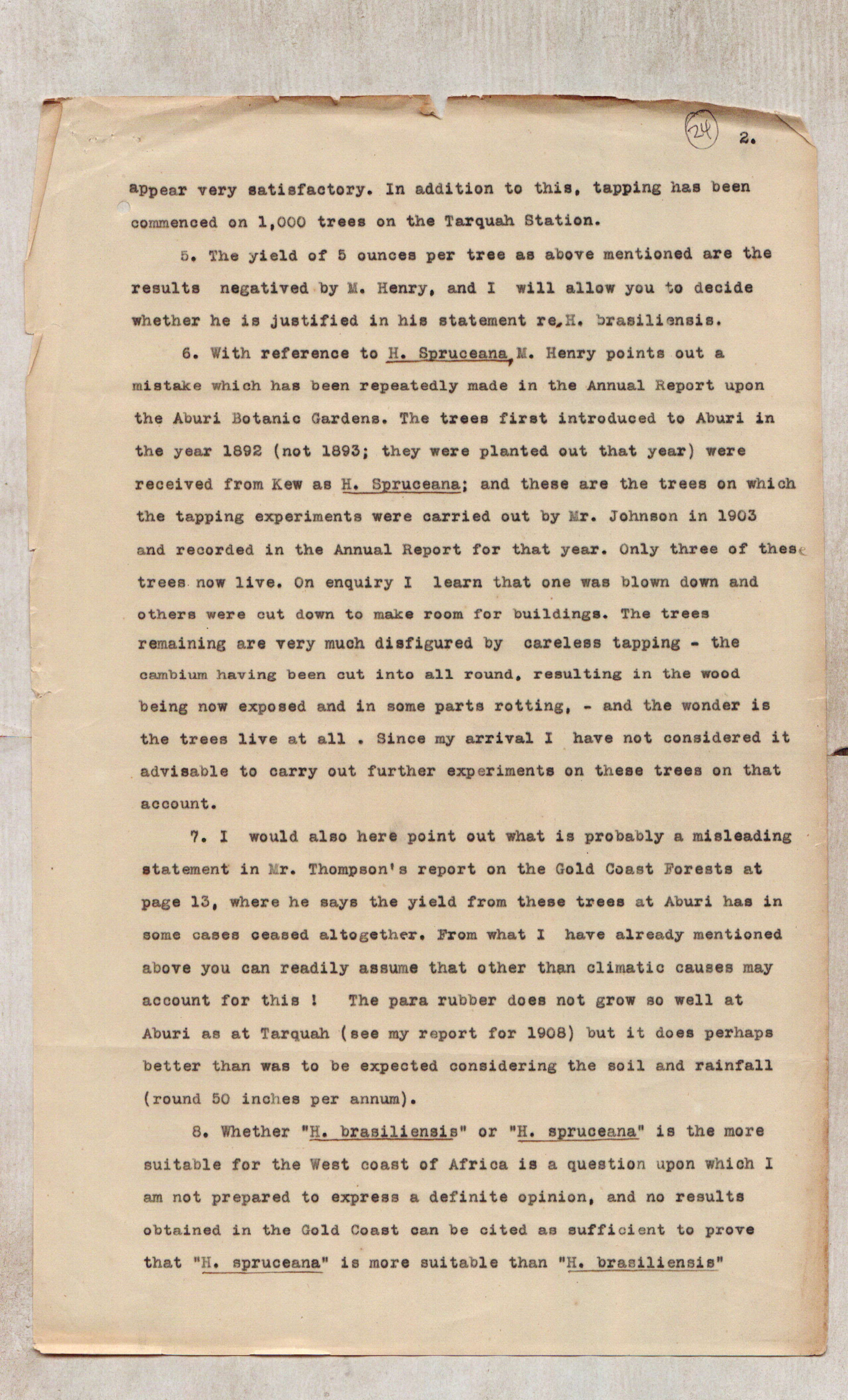
appear very satisfactory. In addition to this, tapping has been commenced on 1,000 trees on the Tarquah Station.
5. The yield of 5 ounces per tree as above mentioned are the results negatived by M. Henry, and I will allow you to decide whether he is justified in his statement re, H. brasiliensis .
6. With reference to H. Spruceana, M. Henry points out a mistake which has been repeatedly made in the Annual Report upon the Aburi Botanic Gardens. The trees first introduced to Aburi in the years 1892 (not 1893; they were planted out that year) were received from Kew as H. Spruceana; and these are the trees on which the tapping experiments were carried out by Mr. Johnson in 1903 and recorded in the Annual Report for that year . only three of these trees now live. On enquiry i learn that one was blown down and others were cut down to make room for buildings.The trees remaining are very much disfigured by careless tapping the cambium having been cut into all round. resulting in the wood being now exposed and in some parts rotting,- and the wonder is the trees live at all. Since my arrival I have not considered it advisable to carry out further experiments on these trees on that account.7. I would also here point out what is probably a misleading statement in Mr. Thompson's report on the Gold Coast Forests at page 13, where he says the yield from these trees at Aburi has in some cases ceased altogether. From what I have already mentioned above you can readily assume that other than climatic causes may account for this ! The para rubber does not grow so well at Aburi as at Tarquah ( see my report for 1908) but it does perhaps better than was to be expected considering the soil and rainfall (round 50 inches per annum).
8. Whether "H. brasiliensis" or "H. spruceana" is the more suitable for the West coast of Africa is a question upon which I am not prepared to express a defin ite opinion , and no results btained in the Gold Coast can be cited as sufficient to prove that 'H. spruceana" is more suitable than "H. brasiliensis"
Typed from the scan. Spellings follow the original and may contain mistakes.