International Rubber Exhibition
Transcription
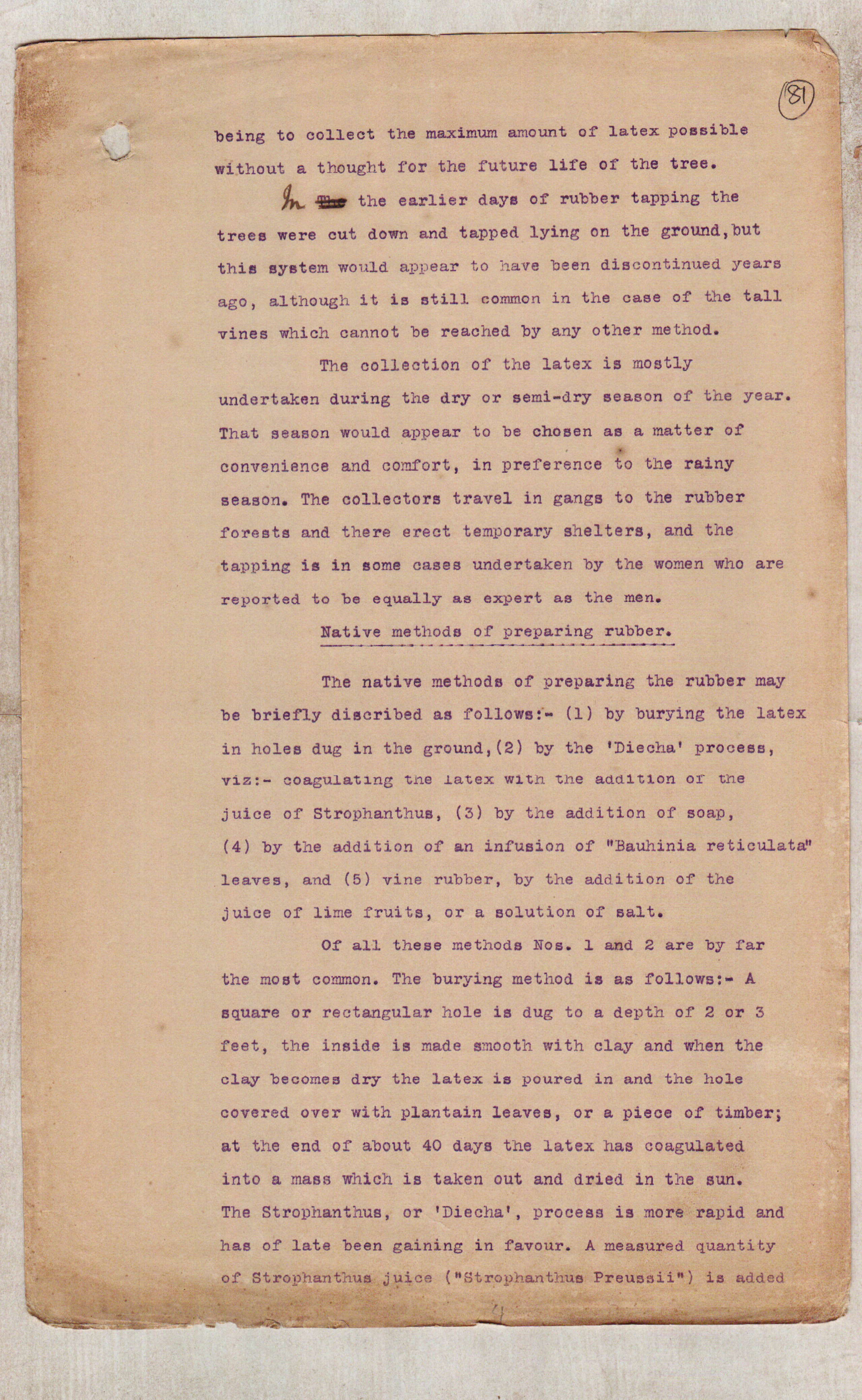
being to collect the maximum amount of latex possible without a thought for the futher life of the tree In the earlier days of rubber tapping the trees were cut down and tapped lying on the ground, but this system would appear to have been discontinued years ago, although it is still common in the case of the tall vines which can not be reached by any other method. The collection of the latex is mostly undertaken during the dry or semi-dry season of the year. That season would appear to be chosen as a matter of convenience and comfort, in preference to the rainy sseason. The collectors travel in gangs to the rubber forests and there erect temporary shelters, and the tapping is in some cases undertaken by the women who are reported to be equally as expert as the men.
Native methods of preparing rubber.
The native methods of preparing the rubber may be briefly discribed as follows:- (1) by burying the latex in holes duz in the ground. (2) by the "Diecha" process, viz:- coagulating the latex with the addition of the juice of Strophanthus. (3) by the addition of soap, (4) by the addition of an infusion of "Bauhinia reticulata" leaves, and (5) vine rubber, bythe addition of the juice of lime fruits, or a solution of salt. Of all these methods Nos. 1 and 2 are by far the most common. The buring method is as follows:- A square or rectangular hole is dug to a depth of 2 or 3 feet, the inside is made smooth with clay and when the clay becomes dry the latex is poured in and the hole covered over with plantain leaves, or a piece of timber; at the end of about 40 days the latex has ciagulated in to a mass which is taken out and dried in the sun. The Strophanthus juice("strophanthus Preussii") is added
Typed from the scan. Spellings follow the original and may contain mistakes.