Untitled case file
Transcription
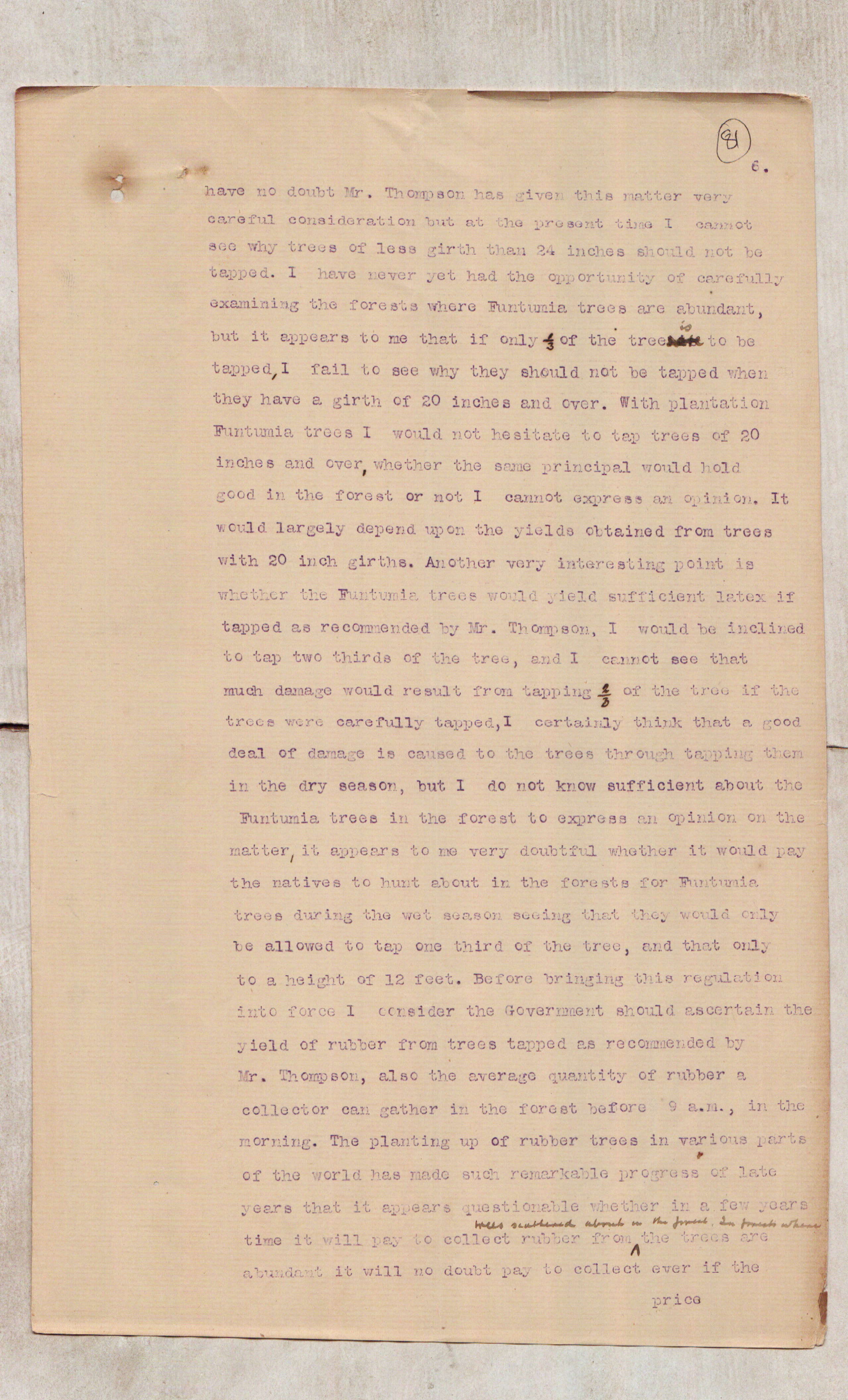
have no doubt Mr. Thompson has given this matter very careful consideration but at the present time I cannot see why trees of less girth than 24 inches should not be tapped. I have never yet had the opportunity of carefully examining the forests where Funtumia trees are abundant, but it appears to me that if only 1/3 of tree is to be tapped . I fail to see why they should not be tapped when they have a girth of 20 inches and over. With plantation Funtumia trees I would not hesitate to tap trees of 20 inches and over whether the same principal would hold good in the forest or not I cannot express an opinion. It would largly depend upon the yields obtained from trees with 20 inch girths. Another very interesting point is whether the Funtumia trees would yield sufficient latex if tapped as recommended by Mr. Thomoson, I would be inclined to tap two thirds of the tree, and I cannot see that much damage would result from tapping ¾ of the tree if the trees were carefully tapped, I certainly think that a good deal of caused to the trees through tapping them in the dry sesson, but I do not know sufficient about the Funtumia trees in the forest to exprees an opinion on the matter it appears to me very doubtful whether it would pay the natives to hunt about in the forests for Funtumia trees during the wet season seeing that they would only be allowed to tap one third of the tree, and that only to a height of 12 feet. Before bringing this regulation into force I consider the Government should ascertain the yield of rubber from trees tapped as recommended by Mr. Thompson, also the average before 9 a.m. in the morning. The planting up of rubber trees in various parts of the world has made such remarkable progress of late years that it appears questionable whether in a few years time it will pay to collect rubber from the trees are abuadant it will no doubt pay to collect ever if the
price
Typed from the scan. Spellings follow the original and may contain mistakes.